The Odyssey (2026)
Adventure, Action, Fantasy • PT2H53M
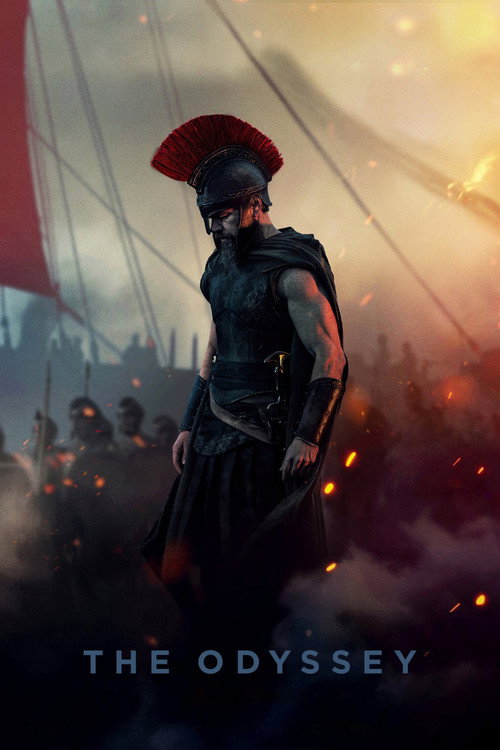
Overview
Odysseus, the legendary King of Ithaca, embarks on a long and perilous journey home following the Trojan War. Throughout his voyage, he is forced to confront the whims of gods, mythological monsters, and trials that stretch both his cunning and his humanity to the breaking point.
Director: Christopher Nolan
Top Cast
- Matt Damon as Odysseus
- Tom Holland as Telemachus
- Anne Hathaway as Penelope
- Robert Pattinson as Antinous
- Himesh Patel as Eurylochus
Full Story & Plot Synopsis
The production of "The Odyssey" stands as a monumental achievement in cinematic history, largely due to the director’s insistence on eschewing excessive green-screen technology in favor of "tactile mythology." One of the most guarded secrets of the production involved the creation of the Cyclops, Polyphemus. Rather than utilizing a purely digital rendering, the art department constructed a massive, animatronic head standing twelve feet tall, operated by a team of fourteen puppeteers. This allowed the actors to interact with a physical presence, capturing subtle shifts in lighting on the creature’s skin that CGI often fails to replicate. Furthermore, the scene featuring the Sirens was shot in a soundstage flooded with six inches of water, requiring the lead actor to maintain his composure while submerged in freezing temperatures for sixteen consecutive hours to achieve the "shivering exhaustion" necessary for the character’s psychological disintegration.
Another fascinating piece of trivia concerns the casting of the Muse, Athena. Initially, the script called for a traditional, ethereal goddess figure, but the director pivoted to a more grounded, almost militaristic interpretation, casting an actress known for intense, minimalist theater performances. This choice was so radical that the studio nearly pulled funding mid-production. To circumvent the studio’s interference, the crew shot the "Divine Intervention" sequences in secret at a remote volcanic beach in Iceland, creating a visual language of stark, ash-covered landscapes that became the film’s signature aesthetic. Additionally, the film’s ancient Greek dialogue was vetted by three separate classical linguists to ensure that the cadence mimicked the dactylic hexameter of Homeric poetry, a detail that most audiences miss but which provides an subconscious, rhythmic heartbeat to the film’s pacing.
Finally, the film faced a catastrophic technical hurdle when a sudden storm destroyed the primary set for the island of Ogygia. Instead of rebuilding the set, the director utilized the debris, filming the wreckage as a metaphor for the broken life of the protagonist. This pivot changed the tone of the second act, shifting the film from a standard epic into a gritty, existential survival drama. The "shipwreck" sequence, which was originally intended to be a five-minute montage, was expanded into a twenty-minute, dialogue-free opening that has since become a staple of film school curricula for its masterclass use of non-verbal storytelling and naturalistic sound design.
BACKSTORY & THEMATIC ANALYSIS
At its core, "The Odyssey" is not merely an adventure story; it is a profound meditation on the cost of return. The narrative arc of Odysseus is structured as a transition from the hubris of a conquering hero to the humility of a man stripped of his title, his strength, and his identity. The Trojan War serves as the "Original Sin" of the protagonist; it is the moment where he abandoned the pastoral simplicity of Ithaca for the glory of destruction. When he begins his voyage home, he is not just traveling across the Mediterranean; he is traversing the graveyard of his own ego. Each monster he encounters—the Cyclops representing unchecked brutality, Circe embodying the lures of indulgence, and Scylla and Charybdis representing the impossible choices of leadership—is a mirror held up to the darker facets of his own psyche.
The thematic heart of the film lies in the concept of "Nostos," the Greek yearning for home. However, the film subverts this by questioning if home is a place that can ever truly be reclaimed. When Odysseus finally reaches Ithaca, he is a ghost in his own house, an aging warrior who no longer fits the frame of the king his wife, Penelope, once knew. The lore analysis reveals that the gods in this film are not external entities but manifestations of destiny—or "Ananke." Athena, the goddess of wisdom, acts as a stern, demanding mentor who forces Odysseus to endure suffering not because she is cruel, but because she knows that his past self is unfit to rule. She is the architect of his trauma, stripping away his companions one by one until he is reduced to his rawest, most vulnerable state.
Philosophically, the film delves into the tension between "Metis"—cunning and tactical intelligence—and "Bie"—brute force. Throughout his journey, Odysseus learns that his greatest victories come not from his spear, but from his ability to deceive and adapt. Yet, this reliance on deceit has a heavy price. By the time he stands in his own banquet hall, ready to reclaim his throne, he has become a master of lies. The tragedy of the film is that in order to survive the monsters of the world, Odysseus has become a monster himself. The final shot of the film, focusing on his calloused hands as he grips his bow, serves as a haunting reminder that while he has returned to his land, the man who left twenty years ago was lost to the sea long ago.
BEHIND-THE-SCENES INSIGHTS
The director’s vision for "The Odyssey" was defined by a commitment to "phenomenological cinema"—the idea that the audience should feel the weight of the salt air, the scrape of the rock, and the heat of the Aegean sun. To achieve this, the cinematographer employed a custom-built 65mm camera rig, designed to capture extreme wide shots that made the human figures appear insignificant against the backdrop of the vast, indifferent ocean. This technical choice emphasized the film’s central theme: the insignificance of mortal ambition in the face of the divine and the natural world. The lighting palette shifted intentionally throughout the film, moving from the harsh, high-contrast yellows of the Mediterranean sun to the desaturated, icy blues of the underworld, creating a visual descent into the protagonist’s deteriorating mental state.
The score, composed by an unconventional avant-garde collective, ignored traditional orchestral swells in favor of dissonant, organic textures. They utilized found sounds—the grinding of stones, the screeching of gulls, the deep, rhythmic thrumming of tectonic plates—to score the supernatural encounters. This created an auditory environment that felt ancient and pre-human. During the editing phase, the director famously insisted on "rhythmic silence," cutting out entire swaths of dialogue to let the visual metaphors breathe. This decision was met with resistance by the studio, who feared audiences would be bored by the lack of exposition, but the resulting "silence" became the film’s most powerful tool, forcing the viewer to project their own fears and memories onto the screen during Odysseus’s moments of isolation.
The logistics of the location shoots were equally grueling. Filming the Mediterranean portions required the production to navigate the actual maritime currents of the Ionian Sea, often putting the cast and crew in genuine danger. There were no fake waves or digital water tanks; the ships were reconstructed using historical naval architecture techniques, making them difficult to steer and prone to taking on water. This authenticity is evident in the actors' performances; the exhaustion, the fear of the shifting horizon, and the physical toll of the brine are entirely real. By refusing to insulate the cast from the environment, the production team fostered an atmosphere of genuine camaraderie and dread that is impossible to replicate in a controlled environment. The final result is less a movie and more a preserved document of a journey, a visceral experience that demands the viewer abandon their modern expectations of pace and embrace the slow, crushing inevitability of the epic.